Traffic Buster: Parking Escape
- 4.8
- Rating
- 5.00M
- Installs
- Free
- Price
 Analysis by App-foxy
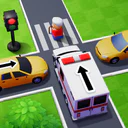
I approached Traffic Buster: Parking Escape expecting a quick puzzle game, and that is exactly where it fits best: short sessions built around untangling crowded parking areas. The basic idea is easy to understand. Cars are packed into awkward positions, and I tap them in a useful order so they can leave without making the situation worse. The challenge is not speed alone; it is reading the whole arrangement before committing to a move.
That makes it a comfortable choice for someone trying a puzzle game for the first time. I never needed a long explanation before starting, and the early stages give the central interaction room to make sense. At the same time, the simple presentation can be misleading. A board that looks almost solved may still require a carefully planned sequence, while one apparently blocked car can become the key to opening the rest of the layout.
What the first few minutes feel like
Traffic Buster: Parking Escape is a free puzzle game from Fancy Game, aimed at Everyone and available for devices running Android 7.0 or later. Its store summary describes the task as clearing traffic jams and solving parking puzzles, but the practical appeal comes from the small decisions between those two points. I am constantly asking which car has a clear route, which move creates space, and which apparently convenient tap will remove an important escape path.
You May Also Like

 Pandora - Music & Podcasts
Pandora’s Music Is Easy to Start, but Harder to Recover
Pandora’s strength is its low-effort path from a seed to a station. Its weak spot is how much confidence it asks you to place in connection, setup, and quiet recovery.

 8 Ball Pool
 Is Built on Rivalries, Rematches, and Routine
A close look at the rivalries, rematches, shared routines, and unanswered safety questions that turn a quick pool match into a persistent mobile community.

 Samsung Music
’s Quiet Strength Is Playing What You Already Own
Its reach comes less from spectacle than from dependable access to a personal library. That simplicity is both the app’s strongest retention engine and its ceiling.

 AccuWeather: Weather Radar
AccuWeather Review: A Quick, Clear Forecast for Everyday Decisions
For everyday plans, the best forecast is the one you can understand quickly. AccuWeather makes rain timing, radar, and local conditions easy to act on, with a few trade-offs.

 Hill Climb Racing
Why Hill Climb Racing Still Turns Crashes Into One More Run
A tiny car, a bumpy hill and one more upgrade: Hill Climb Racing keeps resurfacing because its simple chaos makes every near-miss feel personal.

 AliExpress - Shopping App
AliExpress Makes Global Shopping Feel Personal, but Shoppers Bear the Risk
AliExpress turns a global marketplace into a pocket-sized discovery engine. Its reach is useful, its shopping loop compelling, and its trade-offs easy to miss.
More From Our News Desk
View All News


The game has reached over five million installs and carries a 4.8 average from around 113 thousand ratings, so it is clearly not an obscure experiment. Those figures do not replace personal testing, but they do match my first impression that the concept is immediately accessible. I could understand the goal without learning a complicated rule set, which matters when I want something to play while waiting rather than a game that demands a serious opening session.
The strongest use case is a short break. I can play a few puzzles, put the phone down, and return later without having to remember a large story or a complicated control scheme. It also suits people who enjoy visual ordering problems more than word puzzles or match-three boards. If you like looking at a crowded arrangement and gradually discovering the correct sequence, the central loop has a satisfying rhythm.
It is less suitable for anyone seeking a deep strategy game with character development, exploration, or a long narrative. The pleasure is concentrated in solving the parking arrangement itself. Players who dislike repeating a basic interaction, or who want every stage to introduce a dramatically different mechanic, may find the formula narrow. I would also skip it if your ideal puzzle experience is completely pressure-free and you become frustrated when a single wrong move forces you to reconsider the board.
Installing and getting oriented
The game is free to install, although optional in-app purchases range from $0.99 to $99.99 per item. I recommend treating the free starting experience as a trial rather than assuming that every optional convenience will be necessary. The purchase range is wide enough that anyone managing a family device or a personal budget should be aware of it before handing the phone to a child, even though the content rating is Everyone.
The current version is 1.0.90. On a compatible device, the important first step is simply to launch the game and observe the board before tapping repeatedly. The cars, their directions, and the available gaps communicate most of what I need. I found that rushing into the first visible move is the easiest way to create confusion, especially when a car seems ready to leave but is actually dependent on another vehicle moving first.
I would not approach the opening as a test of reflexes. It rewards a short pause and a scan from the outside toward the center. I look for vehicles with an unobstructed path, then identify which parked cars are preventing access to the next useful lane. This habit is more valuable than trying to memorize a fixed pattern, because each parking puzzle asks me to interpret the arrangement in front of me rather than repeat a universal solution.
For a first-time player, the reassuring part is that the objective remains visible throughout the attempt. I am not solving an invisible rule system. The board shows the problem directly, and each successful move provides visual confirmation that the space is becoming more manageable. That makes the opening minutes approachable even if I normally avoid puzzle games that appear technical.
How I reach the first meaningful success
My most reliable opening routine is to avoid tapping the car that looks most attractive at first glance. Instead, I check whether its route is genuinely open and whether moving it would expose another option. If it is blocked, I search for a vehicle whose movement can create room. This small change in thinking turns the first successful clear from a lucky tap into a repeatable method.
Once I see a possible route, I follow it one decision at a time. I do not try to predict the entire board perfectly, because visual puzzles often become clearer after the first obstruction is removed. The useful question is not “Which car should leave immediately?” but “Which move gives me more choices afterward?” That approach reduces wasted attempts and makes the game feel more like planning than guessing.
A realistic everyday example is playing during a short commute while waiting for an appointment. I might have only enough time for a small number of attempts, so I use the first moment to inspect the layout rather than beginning with frantic taps. If I solve it, the reward is a compact sense of completion. If I do not, I can stop without losing the value of the session, because I have usually learned which part of the arrangement was causing the blockage.
Another useful habit is to work from the edges inward. Cars near an open boundary are often easier to evaluate than those surrounded by several others. Clearing an outside vehicle can reveal the shape of the remaining problem, while moving an interior vehicle too early may leave the board just as crowded. This is not a guaranteed formula for every stage, but it is a practical starting point when the layout initially looks overwhelming.
The best early skill is preserving options, not moving cars quickly. That distinction is easy to miss because tapping is so simple. I get better results when I regard every move as a change to the available space. A move that removes one car but blocks two possible routes is usually weaker than a move that leaves several escape choices open, even if it does not appear to make immediate progress.
Where new players can become confused
The main source of confusion is assuming that a clear-looking vehicle is automatically the correct first choice. In a parking puzzle, visibility and usefulness are not the same thing. I have had boards where the car closest to an exit was less important than a vehicle positioned behind it, because the second car was the one limiting the whole arrangement.
Another common mistake is treating each tap as an isolated action. The board is sequential. A car that is harmless in its current position can become a problem after another vehicle moves, and a route that looks unavailable can open after a single carefully chosen clearance. I therefore pause after meaningful changes instead of continuing with the same plan automatically.
When I get stuck, I do not restart immediately. I first identify the last move that reduced my options. That review is more useful than blaming the entire puzzle. Sometimes the problem is not the first tap but a later decision that placed me in a narrow position. Looking back this way also makes the game less frustrating, because failure becomes information about the order rather than proof that the board is impossible.
Players who prefer to solve everything without assistance may appreciate this process, but anyone expecting every stage to be solved instantly should adjust their expectations. The game’s accessible controls do not mean every arrangement is mentally effortless. A simple interface can still support a surprisingly demanding sequence, especially when several cars appear to compete for the same limited space.
I also recommend avoiding rapid tapping when playing on a small screen. A hurried touch can make it harder to read what changed, particularly when several vehicles are close together. A slower rhythm gives me time to confirm the result of each action and prevents the board from becoming visually confusing. That is a small practical adjustment, but it makes the first sessions feel much more controlled.
How it compares with familiar puzzle alternatives
Compared with match-three games, Traffic Buster: Parking Escape is less about building combinations and more about ordering physical movement. I am not scanning for colors or planning a chain reaction; I am reading lanes, gaps, and dependencies. That makes it a better fit for someone who enjoys spatial reasoning and a weaker fit for someone who wants constant visual effects or automatic momentum after each successful move.
Compared with classic sliding-block puzzles, the parking theme makes the objective more immediately understandable. I can see the vehicles and their intended escape problem without first learning an abstract grid. However, the traffic setting does not remove the need for planning. The board still asks me to think several actions ahead, especially when a vehicle’s position affects access to others.
It also differs from traditional logic games that present one fixed problem and expect a purely deductive solution. The appeal here is more tactile. I inspect the arrangement, make a move, watch the available space change, and update my plan. That makes it friendlier for casual play, although players who want a formal puzzle with a clearly stated proof-like solution may prefer a dedicated logic title.
The trade-off is focus. Because the central interaction is so clear, the game can be relaxing when I want a narrow task, but it may feel repetitive during a long uninterrupted session. I get more from it when I treat it as a sequence of compact challenges instead of expecting a constantly expanding adventure. Short play is where its design feels most natural.
Practical ways to make each attempt easier
My first tip is to count choices rather than cars. A move that leaves three possible follow-up routes is often safer than one that leaves only one, even if both remove a vehicle. This way of judging progress helps when the board has several apparently valid taps and prevents me from confusing visible movement with genuine improvement.
My second tip is to identify bottlenecks before acting. A bottleneck is a car or narrow area that affects several other routes. I mentally mark it and ask whether it should move now or remain in place until surrounding space is prepared. This is especially useful on crowded layouts, where the most central object may be important precisely because moving it too early changes the whole board.
My third tip is to use failed attempts as a map. If a sequence breaks down, I remember the point where the route became restricted and test a different order from there. I do not need to discard everything I learned. Often the opening was sound and only the middle sequence needs adjustment. This makes retries faster and keeps the challenge from feeling like random trial and error.
For parents, the Everyone rating makes the game approachable as a family-friendly puzzle choice, but I would still supervise purchases on a shared device. The free entry point is convenient, while the optional item range means purchase controls remain worth checking. For adults, the same detail matters if the game is being used as a quiet distraction at work or during travel and the device is connected to a payment method.
The game is also a reasonable choice for older phones that meet the minimum operating-system requirement, though the experience will naturally depend on the individual device. I would keep the first session short and see how comfortable the controls feel on the screen before committing to longer play. The puzzle itself does not demand complicated input, so accurate tapping and clear visibility matter more to me than having a high-end gaming setup.
Who should try it, and who should pass
I would recommend it to someone who wants an uncomplicated way into spatial puzzles, especially if they enjoy solving a visible problem through a sequence of small decisions. It works well for short breaks, casual solo play, and players who like the satisfaction of turning a crowded board into an orderly one. The first successful clear arrives naturally once I stop treating the game as a speed challenge.
I would be more cautious recommending it to players who need a strong story, competitive multiplayer, or a large variety of unrelated activities. The parking-clearance concept is the reason to install it, and it is also the reason some people may tire of it. Anyone sensitive to optional spending should also review the purchase choices before allowing unrestricted access, since the game is free to start but includes paid items.
The high average rating from over one hundred thousand ratings suggests broad appeal, while the roughly one thousand six hundred written reviews indicate that many players have taken the time to comment on their experience. I read that popularity as a sign that the basic loop is doing something right, not as a guarantee that every puzzle style will suit every person. My own recommendation depends more on whether you enjoy spatial ordering than on the rating alone.
My final take after settling into the loop
Traffic Buster: Parking Escape succeeds because it makes a familiar frustration—cars trapped in a crowded space—into a clear sequence of manageable decisions. I like that the first meaningful win does not require a complicated tutorial mindset. Once I learn to inspect the board, protect open routes, and move bottlenecks deliberately, the puzzles become more satisfying and less dependent on luck.
Its limitations are equally clear. The focus is narrow, long sessions may feel repetitive, and the presence of optional purchases means I would not treat the free label as the only financial detail worth noticing. It is not the right replacement for a deep strategy game or a story-driven mobile adventure. It is a focused casual puzzle, and judging it by that standard gives the fairest result.
For a first-time user, my advice is simple: install it, take a few seconds to study the opening board, and aim for a move that creates more room rather than merely removing the nearest car. If that way of thinking feels rewarding, the game will probably give you plenty of pleasant short sessions. If you want puzzles built around words, stories, or constantly changing mechanics, another category will serve you better.
Fancy Game has kept the entry point straightforward, and version 1.0.90 represents a game that is easy to pick up without being completely mindless. I would recommend it to friends who enjoy compact spatial challenges and want something free to begin with. My strongest recommendation comes with one condition: play patiently, keep an eye on optional purchases, and let the parking layout—not the urge to tap quickly—guide the solution.
FAQs for Traffic Buster: Parking Escape
01What is Traffic Buster: Parking Escape, and how is the gameplay structured?
Traffic Buster: Parking Escape is a puzzle game focused on clearing crowded parking areas and guiding vehicles safely toward the exit. After trying it, the main appeal is its simple swipe-and-tap control system: you select cars, buses, or other vehicles and move them in the correct order without causing collisions. Levels gradually become more complicated, requiring planning, timing, and careful use of the available space.
02Is Traffic Buster: Parking Escape suitable for beginners and casual players?
Yes. The game is designed to be easy to understand, even for players who do not usually play puzzle games. The early stages introduce the basic mechanics through relatively straightforward parking layouts, while later levels demand more thought and patience. Sessions are generally short, making it a convenient choice for casual play, although some puzzles can become noticeably challenging and may require several attempts.
03Does Traffic Buster: Parking Escape work without an internet connection?
Traffic Buster: Parking Escape can generally be played offline for its core puzzle experience, which is useful when traveling or when you have limited mobile data. However, certain features may depend on an internet connection, including advertisements, online rewards, analytics, updates, or promotional content. Availability can vary by version and device, so it is worth checking the current store listing and testing offline access after installation.
04Are there ads, in-app purchases, or other costs in Traffic Buster: Parking Escape?
The game is typically offered as a free download, but free gameplay may be supported by advertising. You may see ads between levels or after choosing optional rewards, and some versions can include purchases for removing advertisements, obtaining hints, or unlocking bonuses. Before downloading, review the Google Play Store or App Store information and check the purchase settings, especially if children will be using the device.
05What devices are compatible with Traffic Buster: Parking Escape, and is it safe to download?
Compatibility depends on the specific Android or iOS version, device hardware, and the release published by the developer. The game usually runs well on modern smartphones and tablets, but older devices may experience slower loading or reduced performance. For safety, download it only through the official Google Play Store or Apple App Store, verify the developer name, read the requested permissions, and keep the application updated.
Pros
- Simple controls make it easy to start playing immediately.
- Short levels are ideal for quick gaming sessions.
- Increasing traffic creates a satisfying challenge.
- Works well for casual players who enjoy puzzle-solving.
- Bright visuals make cars and obstacles easy to distinguish.
Cons
- Later levels can feel repetitive once the core mechanics are familiar.
- Some puzzles may require trial and error rather than clear planning.
- Mistakes can be frustrating when several moves must be repeated.
- The game may feel too simple for players seeking deep strategy.
- Ads may interrupt the experience
- depending on the version and device.

Traffic Buster: Parking Escape
Gallery